




Silent Sentinel of Nature : Lion Fails to Break Its Armor, Tongue Longer Than the Body
New Delhi.
India’s lush forests, hills and plains are home to many unique and lesser-known species. Among them is the Indian pangolin, a quiet yet extraordinary creature often described as nature’s silent sentinel. Found across the plains, hills, forests and dry regions of the Indian subcontinent, this elusive mammal plays a vital role in maintaining ecological balance.
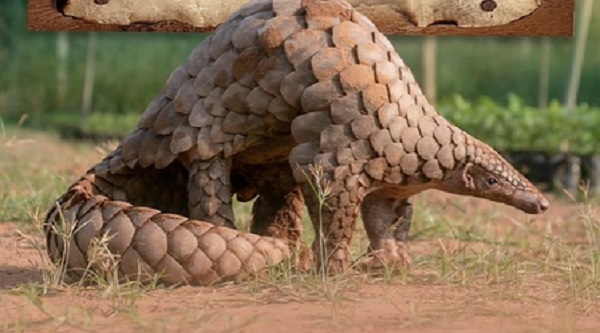
Also known as the thick-tailed pangolin or scaly anteater, the Indian Pangolin is the world’s only mammal covered with hard, overlapping keratin scales. These brown, soil-coloured scales—numbering between 160 and 200—act as a natural shield, offering remarkable protection from predators.
When threatened, the pangolin curls itself into a tight ball, making it nearly impossible for even powerful predators like lions or tigers to pry it open. From head to tail, its body measures between 84 and 122 centimetres, with a tail length of 33 to 47 centimetres, and it weighs around 10 to 20 kilograms. Solitary, shy and slow-moving by nature, the pangolin is nocturnal—resting in burrows during the day and emerging at night in search of food.
Although it does not climb trees, the pangolin prefers areas rich in shrubs, roots and ant or termite mounds. One of its most striking features is its long, sticky tongue, which can extend over 40 centimetres—often longer than its body. Attached near the pelvis and lower ribs, the tongue can reach deep into crevices, effortlessly capturing ants and termites with the help of sticky saliva.
Primarily insectivorous, the pangolin feeds on ants, termites, their eggs and larvae, and occasionally beetles or cockroaches. Using its strong forelimbs and long claws, it breaks open mounds before feeding. By consuming millions of ants and termites, the pangolin helps control insect populations, reducing damage to crops and forests. Its burrowing activity also improves soil aeration and water penetration, further supporting ecosystem health.
Despite its ecological importance, the Indian pangolin is facing a serious threat. It is listed as Endangered on the IUCN Red List and is protected under Schedule I of India’s Wildlife Protection Act. The biggest danger comes from poaching and the illegal international trade of its scales, which are used in traditional medicines and ornaments.
Conservation organisations such as the Wildlife Conservation Trust are working closely with the Madhya Pradesh Forest Department to study the species’ ecology, distribution and habitat use. These efforts aim to develop stronger and more effective conservation strategies to safeguard this gentle guardian of nature.